
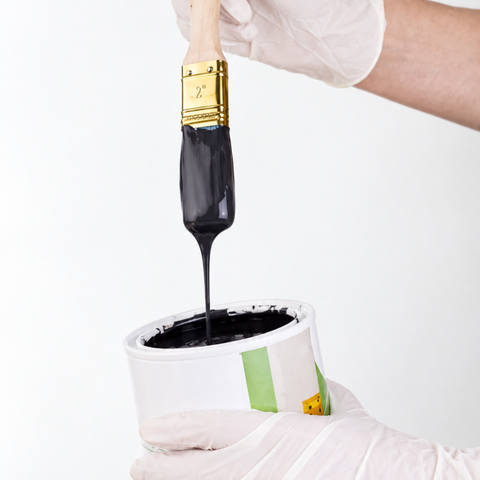
The shift from solvent-borne to waterborne systems in the coatings industry is driven by Volatile Organic Compound (VOC) emission regulations in various markets, ecolabel standards, and demand from corporate customers. For R&D teams, this transition is not simply replacing solvent with water, but upgrading the entire formulation balance, from substrate wetting and dispersion stability to film formation.
This is where water-based additives become a key component. Although their dosage is generally small relative to the total formulation, additives determine whether a low-VOC paint can achieve performance equivalent to solvent-based systems. This article covers the physicochemical challenges of water-based systems, the three main classes of additives along with their trade-offs and how to evaluate them, and a troubleshooting guide for the trial stage.
Why Is Water-Based Paint Formulation Challenging for R&D Teams?
Most of the difficulty is rooted in the nature of water as a medium.
High Surface Tension
Water has a surface tension of around 72 mN/m, while solvents such as xylene and toluene have a surface tension of around 28–30 mN/m. As a result, water-based paint has more difficulty wetting low-surface-energy substrates (plastics, oily metals) and is more prone to wetting defects.
More Complex Pigment Stabilization
Pigment dispersion in water relies on electrostatic and steric mechanisms, so the system is prone to flocculation when the additive combination is not right.
Drying Depends on Environmental Conditions
Water evaporation is strongly influenced by humidity, temperature, and airflow, so drying time and film formation are more variable.
Foam Is Harder to Control
The surfactants and dispersants needed to wet and stabilize pigments also stabilize air bubbles.
To make this easier to follow, here is a summary of the challenges R&D teams will face when developing water-based additive formulations:
Challenge | Physicochemical cause | Effect on the film | Relevant additive class |
Poor substrate wetting | High surface tension | Crawling, craters, poor adhesion | Substrate wetting agent, wetting additive |
Pigment flocculation | Inadequate pigment stabilization | Reduced color strength, unstable viscosity, flooding/floating | Wetting & dispersing additive |
Incomplete film formation | Polymer particles do not coalesce as water evaporates | Cracking, low scrub resistance | Coalescent |
Foam and pinholing | Surfactants stabilize bubbles | Pinholes, craters, poor appearance | Defoamer |
Main Classes of Water-Based Additives for Low-VOC Paint
Low-VOC Coalescents (Eco-Friendly Coalescents)
In latex or acrylic emulsion paints, polymer particles must coalesce as water evaporates to form a continuous film. Coalescents act as temporary plasticizers that lower the minimum film formation temperature (MFFT) so the film can form at application temperature, and then gradually leave the film.
Considerations for R&D:
- VOC definitions differ between regulations. For example, in the European Union VOC is defined by initial boiling point (≤ 250 °C), while other markets apply different test methods and g/L limits. Check the coalescent's classification for your target market, and do not rely only on a “zero-VOC” label.
- Coalescent efficiency is determined by its ability to partition into the polymer phase and lower the MFFT. A dosage that is too low causes cracking at low temperature, while one that is too high can reduce hardness development and block resistance.
- Evaluation: MFFT, film formation at low temperature, scrub resistance, block resistance, and film hardness development.
- Alternatives: binders with low Tg or self-coalescing binders can reduce the need for coalescent, with trade-offs in hardness and block resistance.
High-Performance Wetting & Dispersing Additives
Wetting and dispersing are two different functions. A wetting additive lowers interfacial tension so the liquid wets the pigment surface. A dispersing additive stabilizes pigment particles that are already dispersed, through electrostatic, steric, or combined (electrosteric) mechanisms, so they do not re-agglomerate.
- Common types: polyelectrolyte dispersants (for example polyacrylate salts) for inorganic pigments such as TiO₂ and extenders, and polymeric dispersants with pigment-affinic groups for organic pigments, carbon black, and color pastes.
- Target outcomes: maximum color strength, stable viscosity during storage, and no flooding and floating.
- Trade-offs: highly hydrophilic dispersants can reduce the film's water resistance (risk of blistering), and surface-active additives can stabilize foam.
- Check VOC contribution: some additives are supplied in carriers that contain glycol or solvent. Check the TDS for VOC content (g/L) and APEO-free status.
- Evaluation: viscosity vs. dosage curve, color strength, rub-out test, gloss/haze, and accelerated storage stability.
Defoamers for Water-Based Paint
Foam forms during the grind, let-down, and application stages. Defoamer selection needs to balance foam-breaking effectiveness against the risk of surface defects.
Defoamer type | Advantages | Risks | Generally suited for |
Mineral-oil based | Fast knock-down, relatively low cost | Craters, gloss reduction, or haze if not compatible. | Matt/semi-gloss systems with looser aesthetic tolerance. |
Silicone based (emulsion or compound) | Effective at low dosage | Craters, recoatability problems, risk of silicone contamination on the production line. | Systems proven to be compatible; requires tight control. |
Silicone-free polymer | Crater risk generally lower; safer for recoat | Efficiency sometimes lower, dosage or cost may be higher. | High gloss, clear coats, and coatings with demanding aesthetics. |
Common practice: split the defoamer dose between the grind and let-down stages, then evaluate using a density test (to assess entrapped air), a crater test on panels, and a recoatability test.
(Read also: Integration of VOC-Free BYK Defoamers for Green Manufacturing)
Supporting Additives
- Rheology modifiers (HEUR, HASE, cellulosic): control viscosity, sag resistance, and leveling; the type chosen affects spatter, open time, and wetting.
- Substrate wetting and leveling agents: lower the paint's surface tension to address crawling on substrates that are difficult to wet.
- Flash rust inhibitors: prevent flash rust on steel in waterborne systems.
- Preservatives (in-can preservatives): protect water-based paint from microbial contamination. Read also: The Role of Antibacterial and Anti-Odor Additives in Increasing the Value of Textile and Plastic Products.
(Read also: Types of Paint Additives Every Formulator Should Know)
Water-Based Additive Evaluation Guide
Here are some approaches you can use as a guide for evaluating water-based paint additive formulations:
- Design a dose ladder study for each additive and measure performance and side effects at each level. Overdosing often worsens, rather than improves, performance.
- Watch for interactions between additives. Wetting agents, dispersants, and defoamers influence one another. Evaluate them as a system, not one by one.
- Calculate the total VOC contribution of all additives (including carriers), not just the coalescent.
- Set the order of addition. Dispersants and wetting agents at the grind stage, coalescents and some defoamers at let-down, and rheology modifiers according to type.
- Run accelerated stability tests (for example 50 °C for several weeks) and monitor viscosity, pH, and separation.
- Validate on actual substrates and application conditions, including humidity and temperature representative of the field.
Technical Note: Laboratory-scale results do not always hold at production scale. Different mixing efficiency, shear rate, and aeration can change foam and dispersion behavior. Re-verify on a pilot batch before finalizing the formulation.
Common Troubleshooting in Water-Based Paint
Symptom | Possible cause | Initial action |
Excessive foam during grind | Dispersant/surfactant stabilizes air; defoamer insufficient or incompatible. | Add defoamer at the grind stage, evaluate defoamer type. |
Craters (cratering) | Incompatible defoamer, silicone or oil contamination. | Switch to a silicone-free defoamer, audit contamination sources. |
Pinholing | Entrapped air, film too thick, drying too fast. | Evaluate defoamer/deaeration, film thickness, and drying conditions. |
Flooding/floating | Different pigment mobility, unstable dispersion. | Optimize the dispersant; evaluate the pigment combination. |
Poor wetting on plastic or oily metal | Paint surface tension too high. | Add a substrate wetting agent; check substrate cleanliness. |
Viscosity increase or flocculation after storage | Inadequate dispersant; additive interactions. | Adjust dispersant dosage or type; run accelerated stability test. |
Cracking at low temperature or low scrub resistance | Insufficient coalescent to lower MFFT. | Increase coalescent efficiency or dosage in a controlled manner. |
Flash rust on steel | Water contacts the substrate before the film forms. | Add a flash rust inhibitor; evaluate pH and primer formulation. |
Choosing a Specialty Chemical Distributor for Water-Based Additives
Additive trials are iterative and often require samples, technical data, and formulation discussions. When assessing a specialty chemical distributor, make sure your partner can provide:
- Up-to-date TDS and SDS (covering VOC content, solids, APEO-free status), as well as CoA per batch.
- Regulatory compliance documents relevant to the target market, for example REACH for export to the European Union.
- Access to samples and technical support for starting-point formulations and troubleshooting.
- Batch-to-batch consistency and supply continuity.
- Laboratory facilities and compatibility testing services.
PT Jaya Warindo Abadi, as an industrial chemical distributor operating since 1989, supplies additives for coatings including BYK additives from global principals.
Contact the Jayawarindo technical team to discuss your water-based additive needs and formulation trial support, or visit the Jaya Warindo homepage to view the full portfolio.
Frequently Asked Questions (FAQ)
What are water-based additives?
Water-based additives are small-dose functional materials added to water-based paint formulations to overcome the limitations of water as a medium, such as wetting, pigment dispersion stability, film formation, and foam.
Are all water-based additives VOC-free?
No. VOC content and classification depend on the product composition and the regulatory definition in the target market. Check the TDS for VOC content (g/L), carriers, and the boiling points of the components.
What is the difference between a wetting additive and a dispersing additive?
A wetting additive lowers interfacial tension so that pigments or substrates are wetted. A dispersing additive stabilizes pigment particles that are already dispersed so they do not re-agglomerate.
How do you choose a defoamer for water-based paint?
Choose based on aesthetic requirements and compatibility: mineral oil for tolerant systems, silicone for efficiency in systems proven to be compatible, and silicone-free polymer for high gloss or clear coats. Always test for craters and recoatability.
Low-VOC Paint Formulations Determined by the Best Water-Based Additives
The success of a low-VOC paint formulation is determined by how water-based additives are selected and evaluated as a single system. Understanding the mechanisms and trade-offs of coalescents, wetting & dispersing additives, defoamers, and supporting additives helps R&D teams achieve the expected film performance and aesthetics without adding to the VOC burden. Technical data support, samples, and supply consistency from a competent distributor will speed up the cycle from trial to production.
Tags:water-based additive, water-based paint additive, low-VOC paint, low-VOC coalescent, wetting and dispersing additive, defoamer for water-based paint, waterborne additive, specialty chemical distributor, industrial chemical distributor