
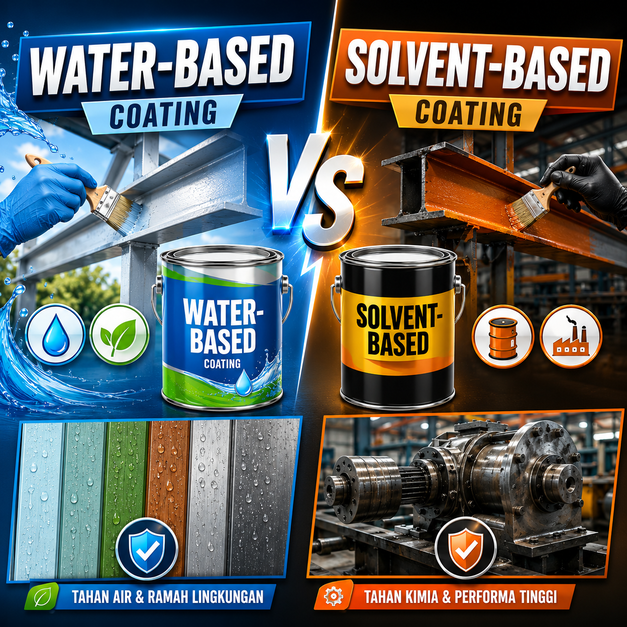
In the coating and paint manufacturing industry, choosing the right coating system is a critical factor that directly impacts product quality, production efficiency, and environmental compliance.
Currently, the two most common coating systems used are water-based coatings and solvent-based coatings. Each system comes with its own unique characteristics, advantages, and limitations depending on the specific needs of the industrial application.
This article will comprehensively cover the differences between water-based and solvent-based coatings, ranging from their composition and performance to drying time and industrial applications.
What is a Water-Based Coating?
A water-based coating is a coating system that utilizes water as the primary carrier/medium to disperse resins and additives. Because water is the main component, the Volatile Organic Compounds (VOC) level in this system is generally lower than that of solvent-based coatings, making it a much more eco-friendly option.
Water-based coatings are widely used in:
- Architectural paint
- Wood coating
- Automotive coating
- Packaging
- Protective industrial coating
Key Characteristics of Water-Based Coatings:
- Low VOC emissions
- Milder odor
- Easy to clean up
- Safer for operators
- Drying mechanism relies on water evaporation
- Environmentally friendly
What is a Solvent-Based Coating?
A solvent-based coating consists of organic solvents acting as the carrier medium for the resin. This type of coating has long been a staple in various industrial coating applications due to its renowned strong adhesion, high chemical resistance, and excellent durability.
Solvent-based coatings are commonly used in:
- Heavy-duty coating
- Marine coating
- Metal coating
- Industrial machinery
- Protective coating
Key Characteristics of Solvent-Based Coatings:
- High chemical resistance
- More stable curing process
- Excellent performance under extreme conditions
- Faster drying time under specific conditions
- Higher VOC levels
- Stronger solvent odor
Key Differences: Water-Based vs. Solvent-Based Coating
To better understand how these two systems compare, let's look at their primary differences across several fundamental parameters.
1. The Carrier Medium
The most fundamental difference lies in the type of carrier (medium) used in the formulation. The carrier dissolves or disperses the resin, aids the application process, controls viscosity, and assists in film formation as the coating dries. The type of carrier chosen significantly affects performance, drying time, safety, VOC emissions, and field application.
- Water-Based: Uses water as the primary carrier. Resins and additives are dispersed or emulsified into the water using specialized technology to keep the coating stable. This results in lower VOCs, milder odors, and significantly lower flammability.
- Solvent-Based: Uses organic solvents such as xylene, toluene, MEK (Methyl Ethyl Ketone), acetone, esters, or other hydrocarbon solvents. These solvents dissolve the resin to achieve the ideal viscosity and flow for application. Due to the rapid and stable evaporation rate of organic solvents, they are highly favored for industrial heavy-duty applications.
2. VOC Content
Volatile Organic Compounds (VOCs) are organic chemicals that easily evaporate into the air at room temperature. In coatings, VOCs come from organic solvents, thinners, carriers, and certain additives. As the coating cures, these solvents evaporate into the atmosphere, creating VOC emissions. Managing VOCs is crucial today due to strict environmental regulations, workplace safety, air quality standards, and global sustainability trends.
- Water-Based: Because water replaces most organic solvents, the VOC emissions are drastically lower, the odor is minimal, and the system is much safer for the environment.
- Solvent-Based: The evaporation of organic solvents releases higher levels of VOCs into the air. Consequently, environmental regulations are driving many industries to transition toward water-based alternatives.
3. Drying Time
Drying time refers to the period required for a coating to reach a specific state after being applied to a substrate. It directly impacts production efficiency, finishing speed, coating quality, energy consumption, and overall manufacturing productivity. Drying time itself is highly influenced by temperature, humidity, airflow, and the type of resin used.
- Water-Based: Drying occurs via water evaporation, particle coalescence, and film formation. Because water evaporates differently than organic solvents, the drying behavior of water-based coatings is highly sensitive to environmental conditions (like humidity).
- Solvent-Based: Drying happens through solvent evaporation, resin film formation, and specific curing reactions depending on the resin type. Since organic solvents are highly volatile, the drying process tends to be faster and more stable across various environmental conditions.
4. Adhesion and Durability
Adhesion (the ability to stick to substrates like metal, wood, plastic, concrete, or glass) and durability (long-term resistance to weather, UV, chemicals, abrasion, and thermal stress) dictate the lifespan of the protection, maintenance costs, and total lifecycle costs. Proper adhesion prevents premature peeling, delamination, cracking, or blistering.
- Water-Based: Modern water-based technology has advanced rapidly, allowing these coatings to deliver exceptional adhesion and durability across many industrial applications, though their overall performance profile still differs from traditional solvents.
- Solvent-Based: Traditionally recognized for its unmatched adhesion, especially on heavy-duty industrial surfaces, it remains the gold standard for applications demanding extreme durability.
5. Safety and Environmental Impact
Modern manufacturing prioritizes operator safety, environmental regulations, sustainability, and emission impacts alongside cost and performance.
- Water-Based: Generally much safer because the water carrier reduces the risk of flammability, solvent vapor exposure, and hazardous chemical contact, making handling and storage easier. However, proper PPE and ventilation are still required since they can still contain chemical irritants, preservatives, or coalescing agents.
- Solvent-Based: Uses highly volatile solvents, meaning it requires stricter safety controls due to higher fire risks, intense vapor presence, more complex waste management, and higher energy consumption.
Pros and Cons Comparison
Water-Based Coatings
- Pros: Eco-friendly (low VOC), enhanced operator safety (lower fire risk), low odor (ideal for enclosed spaces), and easy cleanup using standard water.
- Cons: Highly sensitive to humidity, slower drying under certain conditions, potentially lower corrosion resistance in specific setups, and requires precise additive formulation.
Solvent-Based Coatings
- Pros: Exceptional durability for heavy industrial settings, excellent chemical resistance under extreme conditions, powerful adhesion to metals, and a highly stable/consistent drying performance.
- Cons: High VOC emissions, strong chemical odor, elevated flammability risks, tightening environmental regulations, and demanding specialized handling and disposal.
Industrial Applications
Coating Type | Ideal Applications |
Water-Based | Architectural paint, Furniture coating, Interior coating, Eco-friendly coating systems, Packaging industry. |
Solvent-Based | Heavy equipment, Marine coating, Industrial machinery, Protective steel coating, Automotive refinishing. |
How to Choose the Right Coating for Your Industry
When selecting the ideal system, industries should evaluate the following factors:
- Environmental Conditions: Will the coating be exposed to indoor or outdoor environments?
- Chemical Resistance: Will the surface encounter harsh chemicals, solvents, or heavy moisture?
- Environmental Regulations: Does your facility or industry have strict VOC limits?
- Production Efficiency: What are your requirements regarding drying time and curing setups?
- Cost and Maintenance: What is the total application cost versus the expected protective lifespan of the coating?
The Crucial Role of Additives and Resins
Regardless of whether you choose a water-based or solvent-based system, the ultimate performance relies heavily on the resin system and specialty additives like dispersing agents, wetting agents, defoamers, and rheology modifiers. Selecting the right additives is what truly elevates gloss, adhesion, leveling, durability, and overall coating performance.
Conclusion
The choice between water-based and solvent-based coatings comes down to balancing your carrier media, VOC requirements, performance targets, and specific industrial applications. Water-based systems win on eco-friendliness, safety, and low VOCs. Meanwhile, solvent-based systems remain irreplaceable for heavy-duty applications demanding high durability and robust chemical resistance.
With the correct resin and additive formulation, both systems can deliver optimal performance tailored to your operational needs.
Consult Your Industrial Coating Needs
Choosing between water-based and solvent-based systems requires careful technical consideration. PT Jaya Warindo Abadi is ready to assist you with:
- Coating raw material selection
- Additive recommendations
- Custom formulation solutions
- Enhancing overall coating performance for your manufacturing needs
Contact us today to receive expert product consultations and the best coating solutions for your manufacturing applications.