
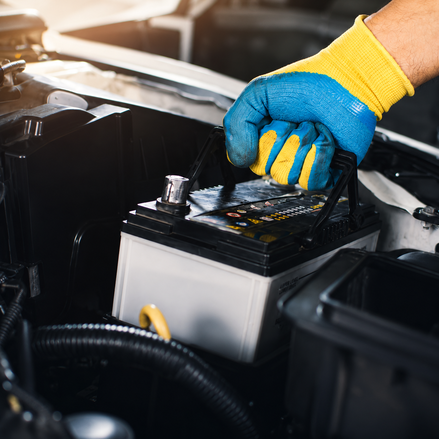
When people talk about batteries — whether conventional lead-acid car batteries, lithium-ion cells, or EV power packs — the conversation almost always centres on capacity, voltage, and lifespan. Rarely does anyone bring up what makes those numbers possible: the chemical additives engineered into every cell.
In battery manufacturing, additives are not supplementary ingredients. They are components that directly determine whether a battery cell will perform reliably for years, or degrade faster than it should.
This article is written for procurement teams, production managers, and business decision-makers in the battery manufacturing industry who want to understand the additive landscape — what the main categories are, what they do, and why choosing the right industrial chemical distributor is a direct factor in final product quality.
The Battery Industry in Indonesia: Context and Opportunity
Indonesia sits in a strategically important position in the global battery value chain. As one of the world's largest producers of nickel — a key raw material in lithium-ion batteries — Indonesia is actively building a battery manufacturing ecosystem from upstream to downstream, including through major projects in the electric vehicle (EV) sector.
At the same time, the conventional lead-acid battery industry remains very large in Indonesia, serving the needs of motor vehicles, industrial backup power systems, telecommunications infrastructure, and solar energy applications. Both segments — lead-acid and lithium-ion — have distinct additive requirements, and both are equally critical.
Additives in Lead-Acid Batteries
Lead-acid is the oldest battery technology still in mass use — and behind its continued reliability lies a set of additives that play a crucial role in both performance and longevity.
1. Expanders
The expander is the most important additive in the negative plate of a lead-acid battery. Without it, battery capacity deteriorates rapidly due to uncontrolled lead sulphate (PbSO4) crystallisation.
Primary functions of expanders:
- Prevent excessive lead sulphate crystallisation — which causes sulphation and permanent capacity loss
- Maintain electrode porosity — so that electrolyte can circulate and electrochemical reactions proceed efficiently
- Extend battery cycle life — particularly under partial state of charge (PSoC) conditions common in automotive start-stop applications
Expanders are typically composed of three main components: lignosulphonate (a wood-derived organic), barium sulphate (BaSO4), and carbon black. The composition and quality of each component directly determines the expander's overall performance.
2. Sodium Lignosulphonate and Lignosulphonate Grades
Lignosulphonate is the organic component in the expander that acts as an inhibitor of lead sulphate crystallisation. The quality and grade of lignosulphonate used directly influences low-temperature battery capacity (cold cranking ampere / CCA) and resistance to repeated charge-discharge cycling.
Technical note: Not all lignosulphonates deliver the same performance. Differences in molecular weight, degree of sulphonation, and residual sugar content can produce significant differences in battery performance. This is one area where raw material quality consistency from batch to batch is absolutely critical.
3. Antimony and Lead Alloy Additives
In the grid construction (electrode framework) of lead-acid batteries, antimony has traditionally been used as an alloying additive to improve lead hardness and corrosion resistance. However, because antimony increases the self-discharge rate, modern technology has shifted to lead-calcium (Pb-Ca) alloys for VRLA and MF (maintenance-free) battery types.
Lead-calcium-tin (Pb-Ca-Sn) alloys have now become the industry standard for maintenance-free batteries, providing the optimal balance between mechanical strength, corrosion resistance, and minimisation of hydrogen gas generated during charging.
4. Fumed Silica and Gel-Formers for VRLA Batteries
In VRLA (Valve Regulated Lead-Acid) gel-type batteries, pyrogenic silica — commonly known as fumed silica — is used to convert the liquid electrolyte into a non-spillable gel. The type and particle size distribution of the silica directly determines gel homogeneity, battery internal resistance, and gas recombination efficiency.
Additives in Lithium-Ion (Li-Ion) Batteries
Lithium-ion technology dominates the consumer electronics market, electric vehicles, and large-scale energy storage systems. Its complexity far exceeds that of lead-acid — and the role of additives within it is correspondingly more intricate.
1. Electrolyte Additives
The electrolyte in a lithium-ion battery is not simply an ion-conducting medium — it must remain electrochemically stable across a wide voltage window, be compatible with both electrodes, and be safe from the risk of thermal runaway.
Key electrolyte additives and their functions:
- Vinylene Carbonate (VC): the most widely used additive for forming a stable SEI (Solid Electrolyte Interphase) layer on the graphite anode. A well-formed SEI reduces irreversible capacity loss in early cycles and extends overall cycle life.
- Fluoroethylene Carbonate (FEC): used in silicon or silicon-graphite composite anode systems; forms a more flexible SEI capable of accommodating silicon's volume expansion during charging.
- LiPF6 stabilisers: additives that protect lithium hexafluorophosphate salt against hydrolysis and thermal degradation.
- Flame retardant additives: organophosphorus compounds or ionic additives that reduce electrolyte flammability without significantly compromising ionic conductivity.
2. Electrode Binder Additives
Binders are polymers that bond active material particles (cathode or anode) and carbon black to the current collector foil. Choosing the right binder determines the mechanical integrity of the electrode across thousands of charge-discharge cycles.
- PVDF (Polyvinylidene Fluoride): the standard binder for cathode electrodes; requires NMP (N-Methyl-2-pyrrolidone) as a processing solvent.
- CMC + SBR (Carboxymethyl Cellulose + Styrene-Butadiene Rubber): the dominant water-based binder system for graphite anodes; more environmentally friendly than NMP-based systems.
- PAA-based binders (Polyacrylic Acid): a next-generation binder better suited for high-capacity silicon anodes that require greater binder elasticity to accommodate volume changes.
3. Conductive Additives
Battery electrode active materials are generally semiconducting or insulating. Conductive additives are incorporated to build an electronic conduction network that allows current to flow to and from active material particles efficiently.
- Carbon Black (Super P, Ketjenblack): the most widely used conductive additive; forms a conductive network between active material particles.
- Carbon Nanotubes (CNTs): the next generation of conductive additives; higher conductivity at lower loading levels, reducing electrode weight.
- Graphene and Reduced Graphene Oxide (rGO): provide both conductivity and mechanical flexibility, particularly relevant for silicon-based electrodes.
Battery Additive Types and Their Functions: Summary Table
The table below summarises the key additive categories, the battery types they apply to, and their impact on product performance:
Additive Category | Battery Type | Primary Function | Performance Impact |
Expander (Lignosulphonate, BaSO4, Carbon Black) | Lead-Acid | Prevent sulphation, maintain negative electrode porosity | More stable capacity, longer cycle life |
Pb-Ca-Sn alloy additives | Lead-Acid VRLA/MF | Improve grid hardness and corrosion resistance, minimise gassing | Maintenance-free operation, lower self-discharge |
Fumed Silica | Lead-Acid VRLA Gel | Convert liquid electrolyte into non-spillable gel | Improved safety, multi-orientation mounting |
Vinylene Carbonate (VC) | Li-Ion | Stable SEI formation on graphite anode | Reduced irreversible capacity loss, longer cycle life |
PVDF / CMC+SBR Binder | Li-Ion | Bond active material to current collector | Electrode integrity across thousands of charge-discharge cycles |
Conductive Additives (Carbon Black, CNTs) | Li-Ion | Build electronic conduction network within the electrode | Better rate capability, lower internal resistance |
Procurement Challenges for Battery Additives in Indonesia
Batch-to-Batch Specification Consistency
In the battery industry, even small variations in additive quality — particularly for materials like lignosulphonate and electrolyte additives — can meaningfully shift battery performance. Molecular weight variation in lignosulphonate between batches, for example, can produce measurable changes in the CCA (cold cranking ampere) characteristics and cycle life of a lead-acid battery.
Procurement implication: Every additive delivery should be accompanied by a Certificate of Analysis (CoA) with product-specific parameters — not a generic CoA. The distributor you choose must be able to provide CoAs from different production lots for long-term consistency verification.
Availability of Specialty Products
Not all battery additives are readily available on the local market. Some specialty products — such as specific lignosulphonate grades for EV applications, or the latest generation of electrolyte additives — require a distribution partner with a strong supply network from global manufacturers.
Procurement implication: Choose a partner who doesn't simply pass on orders (indent-based), but maintains regular stock and a planned procurement commitment from the manufacturer.
Material Safety and Handling
Some battery additives — particularly those used in lithium-ion electrolyte systems — require special handling because of their reactivity with moisture or flammability. This means your distributor must maintain appropriate storage facilities and have a complete, up-to-date Safety Data Sheet (SDS) for every product they supply.
Jayawarindo: Your Chemical Procurement Partner for the Battery Industry
As an experienced battery additive distributor in Indonesia operating since 1989, PT Jaya Warindo Abadi serves the chemical needs of multiple industrial sectors across Indonesia — including industries with demanding specialty chemical requirements and tight technical specifications, such as battery manufacturing.
We understand that procurement in the battery industry operates under a different set of rules from other sectors. Quality consistency isn't an option here — it's a baseline requirement. Any variation in raw material quality can have a direct impact on the performance and safety of the end product that reaches the user.
What Jaya Warindo Abadi offers for your battery industry chemical needs:
- Complete per-batch documentation — authentic CoA and current SDS for every product we distribute.
- Technical procurement consultation — our technical team can help identify the right product grade and specification for your production process requirements.
- National distribution network — warehouse and delivery coverage across Jakarta, Surabaya, Semarang, Solo, Bandung, and Medan.
- Track record and supply stability — over three decades of partnerships with leading global chemical manufacturers, including BYK-Chemie GmbH, Chuangsha, Songwon, and Thor.
Discuss your battery additive requirements with the Jayawarindo team. Contact the Jayawarindo team for a consultation.
Tags: battery additive, batteery additive industry, battery chemical, battery additive Indonesia, distributor bahan kimia industri, supplier kimia industri, distributor additive Indonesia, additive baterai indonesia