
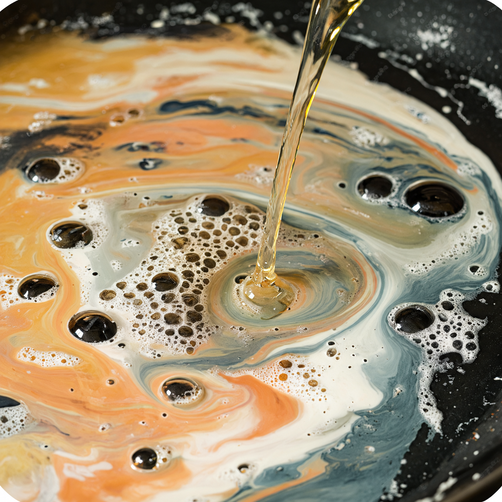
In the modern paint and coatings manufacturing ecosystem, industry trends continuously shift toward waterborne systems to meet increasingly stringent environmental regulations regarding volatile organic compound (VOC) emissions. However, this transition brings unique technical challenges for the R&D department. One of the most persistent and costly issues frequently encountered in the field is foam generation.
The presence of uncontrolled foam is not merely an aesthetic issue, but a threat to the coating's functionality. Air trapped within the paint matrix can create pathways for moisture and corrosive agents, ultimately leading to coating system failure. To address this issue effectively, formulators absolutely require chemical intervention through precisely formulated defoamer additives.
This article will thoroughly dissect the diagnostic process of foam-induced surface defects and provide a technical guide on selecting the most appropriate anti-foam additives for your coating systems.
Understanding the Causes of Foam Generation in Paint Formulations
Before discussing solutions, it is essential to understand how foam forms and why it can become stable. Foam is essentially a dispersion of gas (usually air) within a liquid medium. In pure liquids like pure water, any formed air bubbles will rapidly rise to the surface and burst instantly. Foam cannot be stable without stabilizing agents.
In paint formulations, particularly water-based systems, there are various surface-active surfactant molecules. These surfactants—which include wetting agents, dispersants, resin emulsifiers, and rheology modifiers—are crucial for stabilizing pigment particles and lowering surface tension so the paint can wet the substrate.
However, these same surfactant molecules will migrate to the liquid-air interface whenever the formulation undergoes mechanical agitation, such as during milling, pumping, high-speed mixing, or application using rollers and sprays.
These surfactants form an elastic film (lamella) around the air bubbles. Through a phenomenon known as the Marangoni effect and double-layer electrostatic repulsion, this protective liquid film becomes incredibly strong and resists thinning, thereby making the foam thermodynamically stable. Herein lies the formulator's irony: the very ingredients needed to make the paint function properly are the ones that trigger destructive foam generation.
(Read also: How to Effectively Solve Defoaming (Excessive Foam) Issues in Water-Based Paint Formulations)
Identifying Foam-Induced Surface Defects
QC and R&D teams must be able to distinguish surface defects to determine which type of additive is most effective. Generally, entrapped air is categorized into macro-foam (large bubbles visible on the surface) and micro-foam (microscopic air bubbles trapped within the paint film matrix).
Here is the morphological diagnosis of the most common defects:
1. Pinholing
Pinholing occurs when microscopic air bubbles trapped within a newly applied paint layer manage to rise and burst at the surface just as the paint film begins to dry.
Because the paint has lost its leveling ability, the liquid cannot close back over the tiny 'crater' left by the popped air bubble. The result is needle-sized pinholes that penetrate down to the substrate, creating a shortcut for water to cause corrosion or wood decay.
2. Cratering
Although often confused with pinholing, cratering stems from a different root cause. Cratering is typically the result of macro-foam bubbles bursting at the surface during application, combined with extreme local differences in surface tension (usually due to oil contamination or the use of an incompatible defoamer). The liquid paint is pulled away from the center of the bubble, leaving a shallow but wide depression akin to a lunar crater.
3. Loss of Gloss
Sometimes micro-foam does not have time to rise to the surface and becomes permanently trapped near the surface layer of the hardened paint film. These invisible microscopic bubbles diffuse the reflection of light. Consequently, paint that should possess a high-gloss finish appears dull and hazy.
4. Density Issues in the Production Process
Beyond post-application visual defects, foam causes serious problems during the production stage. Entrapped air artificially increases the volume of a paint batch, thereby lowering its density or specific gravity. This leads to packaging efficiency issues, where the volume of the paint can is full, but the product weight has not met the standard stated on the label.
Mechanism of Action and Selection of Defoamer Additives
To combat foam stabilization, R&D utilizes defoaming agents. Scientifically, these additives are divided into two categories based on their working area: Deaerators, which function to accelerate the rise of micro-bubbles from within the liquid to the surface, and Defoamers, which serve to burst existing macro-bubbles on the liquid surface. Often, modern commercial additives are designed to perform both of these functions simultaneously.
The working principle of a defoamer relies on the concept of incompatibility. For a defoamer to rupture the bubble wall, the active substance of the defoamer must be incompletely soluble in the paint medium and must possess a significantly lower surface tension than the paint solution itself.
When defoamer droplets come into contact with the foam wall, it penetrates the surfactant layer, spreads rapidly, disrupts the elasticity of the foam's protective film, and ultimately causes the air bubble to burst.
Defoamer Chemical Categories for Your Formulations
The selection of defoamer chemical compounds heavily depends on the solvent resin system (binder) and the desired final gloss level.
Generally, there are three fundamental technologies in defoamer formulation:
1. Mineral Oil-Based Defoamers
These are the traditional, economical workhorses, highly effective for decorative architectural paints ranging from matte to semi-gloss finishes, as well as highly pigmented coatings. Their drawback is their susceptibility to triggering compatibility issues (separation) if used in high-end industrial clear coatings.
2. Silicone-Based Defoamers
These utilize modified polysiloxane derivatives, representing a highly reactive and potent type of defoamer at very low dosages. They are exceptional at bursting micro-bubbles and are absolutely vital for airless spray applications and premium industrial paints (high-gloss, automotive, wood). The primary challenge is that if the dosage is incorrect, overly incompatible silicone will cause severe cratering and interfere with intercoat adhesion.
3. Silicone-Free Polymeric Defoamers
This cutting-edge generation offers the perfect balance. They provide outstanding compatibility akin to mineral oil, but with micro-foam elimination efficacy approaching that of silicone. Highly recommended for clear coat applications where visual defects and even the slightest turbidity cannot be tolerated.
The Importance of Partnering with a Credible Defoamer Additive Supplier
The greatest defoamer paradox faced by formulators is balancing 'Efficacy' (the ability to break foam) with 'Compatibility' (the ability to blend without triggering defects).
The most powerful foam-destroying defoamers are the most incompatible, yet the more incompatible they are, the greater the risk of causing cratering defects and loss of gloss. Conversely, if it is too compatible, it will dissolve like a regular wetting agent and lose its ability to break foam.
To resolve this technical deadlock, the role of a reliable Defoamer Additive Supplier becomes critical. A good distributor provides more than just a price catalog; they work as your R&D technical consultant. They must facilitate technical support, suggest lab-scale test protocols (such as a Stir Test for foam stability, or a Roller Test for application testing), and guarantee batch-to-batch product consistency stability.
As an experienced industrial chemical distributor since 1989, PT Jaya Warindo Abadi serves the needs of defoamer additives for the paint and coatings industry in Indonesia.
We understand that the needs of a formulator differ from those of the procurement team. You require not just products, but sufficient technical information to make the right formulation decisions upfront. Because every failed iteration in the lab phase means wasted time and money. Contact the Jayawarindo technical team for further discussion regarding the formulation needs for anti-bacterial and anti-odor agents in your products.
Conclusion
Diagnosing the root cause of surface defects in paint films is half the solution. Finding the perfect balance point by incorporating a defoamer additive aligned with your resin system is the key to producing maximally flawless, aesthetic, and protective coatings. This process demands meticulous analytical trial procedures and stringent raw material qualification.