
In the coating industry — whether automotive paints, industrial coatings, wood finishes, or packaging lacquers — the gloss value of a surface is far more than a visual attribute. Gloss is a measurable quality indicator. It reflects how uniformly and completely a coating has been applied over a substrate.
Picture an automotive component manufacturer shipping a batch of parts with inconsistent gloss levels across units. The client will reject the entire shipment — because uneven gloss signals process inconsistency, and process inconsistency means potential defects in the protective layer.
This is where the gloss meter (or gloss metre) becomes indispensable. The instrument measures the intensity of specularly reflected light from a surface and converts it into a numerical value — one that can be documented, compared, and communicated objectively.
What Is a Gloss Meter and How Does It Work?
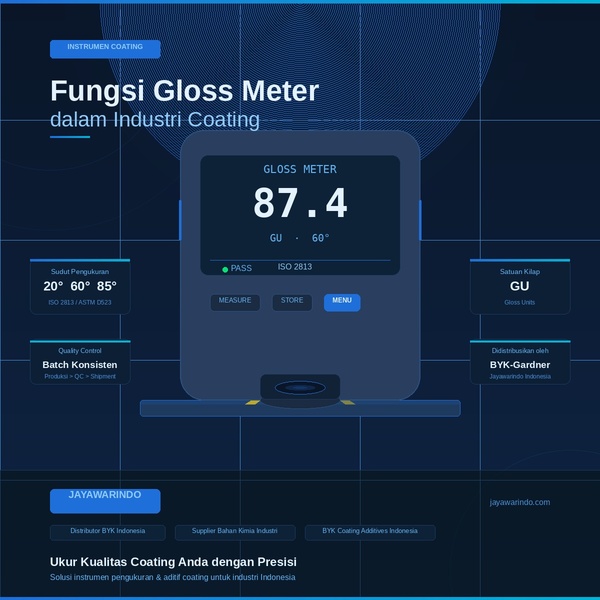
A gloss meter is a precision instrument that measures surface gloss based on specular reflectance — the reflection of light at the same angle as the incident beam. Results are expressed in GU (Gloss Units).
In practice, the instrument projects a light beam at a defined angle onto the surface being tested. A detector on the opposite side captures the reflected light and compares it against a calibration standard — typically a polished black glass tile set at 100 GU.
Three Standard Measurement Angles
Under international standards such as ISO 2813 and ASTM D523, gloss is measured at three different angles depending on the surface's gloss range:
- 20° (High Gloss): For highly reflective surfaces such as automotive paints or premium metal coatings. This angle is most sensitive to subtle variations in very shiny surfaces.
- 60° (Universal / Mid Gloss): The most widely used reference angle for the majority of coating applications. Suitable for surfaces with medium gloss levels.
- 85° (Low Gloss / Matte): For matte, semi-matte, and textured surfaces. At this shallow angle, the instrument is highly sensitive to near-zero reflectance.
Products from BYK Coating Additives — available through Jaya Warindo as an authorized distributor of BYK Coating Additives in Indonesia — are formulated with these gloss parameters in mind, ensuring each additive produces consistent, reproducible GU values across production runs.
5 Key Functions of a Gloss Meter in the Coating Industry
1. Production Quality Control
The most fundamental role of a gloss meter is ensuring that every batch of coating product maintains consistent gloss values. In large-scale manufacturing environments, even minor variations in formulation — additive concentration, application temperature, paint viscosity — can significantly shift GU readings.
By implementing systematic gloss measurements, the QC team can:
- Catch deviations early, before products reach the customer.
- Document batch-level gloss data for full traceability.
- Establish objective, measurable tolerance thresholds.
2. New Product Formulation Development
For R&D teams developing new coating formulations, the gloss meter is the primary evaluation tool. When testing different BYK additives — such as wetting agents, leveling agents, or matting agents — changes in gloss value provide an immediate, objective indicator of each additive's effectiveness.
Without accurate measurement, the development process relies entirely on subjective visual assessment — which simply cannot be reproduced or validated across teams.
3. Contract Specification Verification (Approval Testing)
In B2B transactions, gloss specifications are frequently included as explicit contractual requirements. A household appliance manufacturer, for instance, may require that all coated surfaces meet a value of 85±5 GU at the 60° angle.
The gloss meter serves as the legitimate verification tool for both the coating producer and the buyer, confirming that the delivered product meets the agreed specification — no guesswork, no disputes based on visual perception alone.
4. Damage Analysis and Product Claims
When a gloss-related claim arises — a paint layer that has faded, yellowed, or experienced loss of gloss due to UV exposure — the gloss meter quantifies exactly how much deterioration has occurred. That numerical data forms the objective basis for root cause analysis and fair resolution of the claim.
5. Durability Monitoring and Weathering Tests
In weathering resistance tests, gloss is measured at regular intervals as a primary indicator of coating degradation. A drop in GU values after cycles of UV exposure, humidity, or temperature cycling reveals the extent to which the coating layer has broken down.
BYK Gloss Meters: The Industry Standard for Precision Measurement
Jaya Warindo, as an experienced distributor of BYK gloss meters in Indonesia, provides the full range of gloss measurement instruments from BYK-Gardner — one of the most trusted names in coating measurement technology worldwide.
Available BYK gloss meter products include:
- micro-gloss: A compact gloss meter available in single- or triple-angle configurations, with a digital display and internal memory for data storage.
- micro-gloss S: A connectivity-enabled variant designed for direct integration with digital QC systems.
- rhopoint IQ: A premium instrument that goes beyond standard GU measurement to analyze reflected image quality (DOI/distinctness of image) and haze — essential for automotive and high-end surface applications.
All instruments meet ISO 2813 and ASTM D523 international standards and come with calibration certificates traceable to national and international measurement standards.
For product information and unit availability, contact the Jaya Warindo technical team or browse the full measurement instruments catalogue.
The Role of an Industrial Chemical Supplier in the Coating Ecosystem
Understanding what a gloss meter measures is inseparable from understanding what drives gloss in the first place. This is where the role of an industrial chemical supplier like Jaya Warindo becomes strategically important.
The final gloss of a coating is shaped by several interdependent factors:
- Resin and binder quality that forms the coating film.
- Pigment type and concentration — non-uniform particle size distribution can significantly reduce gloss.
- Formulation additives — leveling agents help the surface flow smooth before it cures; matting agents reduce gloss to a targeted level.
- Application conditions — temperature, humidity, and application technique all directly affect the final GU value.
As the distributor of BYK Coating Additives in Indonesia, PT Jaya Warindo Abadi offers a comprehensive portfolio of BYK additives engineered specifically to optimize coating quality — gloss included. The range covers:
- BYK leveling agents — for smooth, defect-free surfaces (fish eye, orange peel).
- BYK wetting and dispersing agents — ensuring uniform pigment dispersion for consistent gloss.
- BYK matting agents — precisely controlling gloss reduction for matte and semi-gloss applications.
- BYK defoamers — preventing surface bubbles that disrupt film formation and reduce gloss.
How to Choose the Right Gloss Meter for Your Application
Not every gloss meter is right for every application. Here is a practical guide to selecting the right instrument:
Match the instrument to your gloss range
If most of your products are high-gloss — automotive paints, glossy plastics — prioritize an instrument that is accurate at 20°. For matte or semi-gloss products, confirm the instrument supports 85° measurement.
Consider data output and connectivity needs
In modern production environments, a gloss meter with data export capability — USB, Bluetooth, or direct software integration — significantly simplifies documentation and statistical process control.
Verify the calibration standard
The instrument you purchase should come with a certified calibration standard that is traceable to an international reference (NIST-traceable or equivalent). This is non-negotiable for industries where measurements must hold up to third-party scrutiny.
Choose a supplier that offers genuine technical support
A gloss meter is a precision instrument that requires periodic recalibration. Partnering with an industrial chemical supplier that also provides after-sales service and technical consultation — such as Jaya Warindo — ensures your instrument remains reliable over the long term.
Conclusion: Investing in Precision Is Investing in Quality
In a competitive coating industry, the difference between an accepted and a rejected product often comes down to just a few GU. A gloss meter is not simply a measurement tool — it is a quality guardian, enabling manufacturers to speak in numbers rather than impressions.
By combining the right gloss meter from a trusted BYK gloss meter distributor in Indonesia with high-quality coating additives from an authorized BYK Coating Additives distributor in Indonesia, you build a QC system that is solid, traceable, and technically defensible.
Jayawarindo is here as a strategic partner — not only as your industrial chemical supplier, but also as a technical consultant who understands the specific demands of your coating process.
Discuss your gloss meter and coating chemical needs with the Jaya Warindo technical team today.
Tags: gloss meter, gloss meter BYK, BYK gloss meter distributor Indonesia, industrial chemical supplier, BYK Coating Additives distributor Indonesia, surface gloss measurement, coating quality control, BYK-Gardner, coating measurement instruments, paint industry, coating additives Indonesia